
2026-03-16
The Three Value Dimensions of Digital Buildings

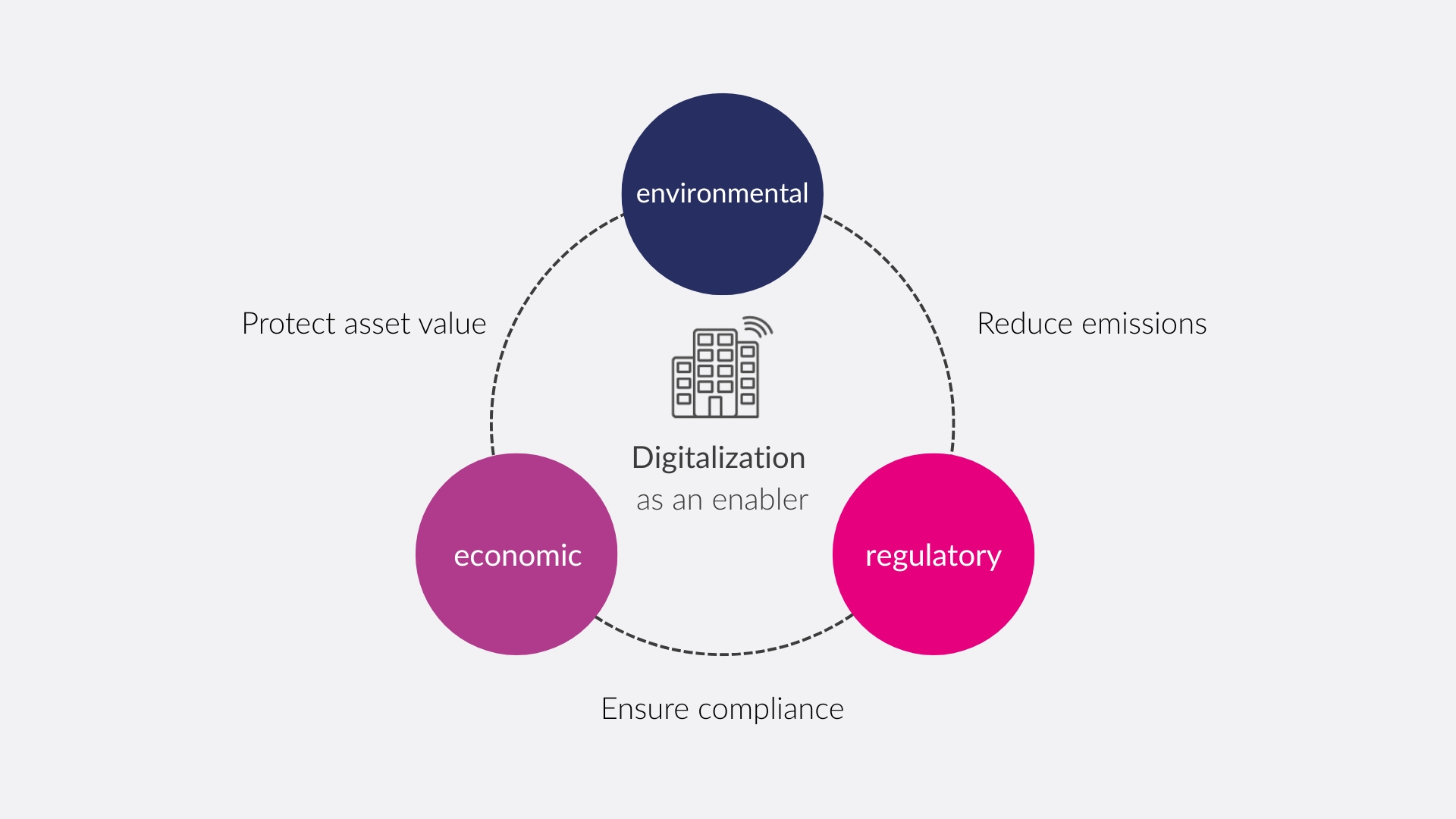
Energy costs are rising, regulatory requirements are tightening, and tenants expect efficient and reliable buildings. At the same time, owners wonder how to ensure the economic stability of their assets while meeting the necessary sustainability goals. The answer is not choosing one goal over the other, but embracing digital operations: only buildings that are continuously monitored, controlled, and optimized digitally can be both sustainable and profitable — and remain competitive in the long term.
Beyond Location: The Importance of Operational Performance
A building’s value is not static. It evolves dynamically with market conditions, user expectations, and operational performance. Beyond the traditional importance of location, real estate value today is determined by operational performance, which is shaped by an interplay of economic targets, ecological goals, and regulatory requirements.
Economic Perspective
Europe's building stock is aging: according to the EU Commission, the majority of buildings date from before the turn of the millennium and consume energy accordingly; 75% are classified as energy-inefficient. What is often underestimated is that buildings are not simple consumers, but technically highly complex systems in which heating, ventilation, cooling, and lighting constantly interact. It is precisely this complexity that makes inefficiencies so difficult to detect. Outdated time programs, incorrectly set control parameters, or systems working against each other often go unnoticed for years, only becoming visible when tenant complaints arise or energy costs noticeably increase. CO₂ pricing adds further economic pressure on inefficiently operated buildings.
At the same time, the shift toward renewable energies brings new challenges, but also new opportunities. Because wind and solar energy are volatile by nature, buildings that can actively manage their energy demand and respond flexibly to price signals are gaining strategic importance. They buffer load peaks and are therefore more resilient to price fluctuations. The potential is considerable: analyses within net-zero scenarios suggest that the building sector could provide a demand-response capacity of several hundred gigawatts by 2030. Smart, data-driven buildings are therefore no longer a vision. They are an economic necessity.
Ecological Perspective
Sustainability is no longer driven by environmental motivation alone. It has become an economic necessity. In their position paper "ESG in Real Estate Valuation," the strategy consultancy PwC demonstrates that properties with strong ESG performance measurably achieve lower operating costs, higher tenant attractiveness, better financing conditions, and higher returns. Buildings with poor energy efficiency and high emission profiles risk price discounts, so-called "Brown Discounts", when being sold, purchased, or re-let. The "Green Value," in the form of low consumption figures, clean data, and clear documentation, thus creates value in three distinct ways:
- it lowers operating costs,
- it protects against regulatory risks and value depreciation,
- it increases attractiveness for tenants, banks, and investors alike
The German Property Federation (ZIA) therefore classifies energy efficiency, operational data transparency, and digital controllability as key valuation dimensions of sustainable portfolios. The savings potential behind this is considerable: according to a Bitkom study, the targeted use of building automation could avoid up to 15 million tons of CO₂ per year. Alongside structural measures such as insulation and the decarbonization of energy sources, building automation is thus one of the central pillars of decarbonization in the building sector.
32 % of European investors are willing to pay a premium for ESG‑compliant buildings — more than half up to 20 %. Source: CBRE (2023).
Regulatory Perspective
In addition to economic and ecological requirements, regulatory frameworks have a direct impact on value creation and are steering the European real estate market decisively toward decarbonization and digital transparency. Examples include the EU Energy Performance of Buildings Directive (EPBD) and the Renewable Energy Directive (RED). The Taxonomy Regulation defines what qualifies as a sustainable investment, and sustainability reporting under the CSRD is becoming an integral part of corporate valuation.
However, sustainability and transparency must be verifiable, documented, and controllable. Article 13 of the EPBD (“Technical building systems”) therefore requires mandatory digital energy monitoring for non‑residential buildings with a combined HVAC rated output above 290 kW starting in January 2025, and from 2030 even for properties exceeding 70 kW. The focus is on open interfaces and manufacturer‑independent communication between all building automation systems.
Since 2010, intelligent automation, control, and monitoring systems have been enshrined in European legislation as key levers for improving energy efficiency. Source: European Commission (2010).
Are Your Properties Already Benefiting From Digital Transformation?
Economic efficiency, sustainability, and regulatory compliance in building operations are closely interconnected. Digitalization – particularly through cloud-based platforms, AI, and automated optimization – creates the foundation for unlocking these potentials.
In our white paper, together with leading partner companies, we demonstrate through concrete practical examples how owners and asset managers can reduce asset costs, minimize risks, and safeguard the value of their portfolios through digitally managed operations.

Conclusion: Digitalization as an Enabler
Modern non‑residential buildings are highly interconnected infrastructures. Against this backdrop, the digital transformation of existing property portfolios is becoming an increasingly central factor in value development. The goal, however, should not be digitalization for its own sake, but value creation through better decision‑making and more efficient building operations, including:
- Automated and complete data collection within a cloud platform as the central standard trade of technical building equipment (TBE)
- AI based and continuous analysis of technical systems to proactively detect inefficiencies and malfunctions, including real time optimization recommendations to reduce energy consumption, operating costs, and CO₂ emissions
- AI based predictive control based on weather forecasts and electricity prices
- Intelligent energy management to leverage dynamic electricity tariffs, enable buildings to serve as energy storage, and support the transition to renewable energies
- Compliance with regulatory requirements, such as § 71a of the German Buildings Energy Act (GEG) or the Décret BACS in France, concerning building automation and digital energy monitoring
The result is an operational model that is both economically robust and ecologically high‑performing. In this context, value is not created through one‑off investments but through continuous digital optimization of building operations.
Buildings Simply Made Better
Get in Touch With US!
In a one-on-one meeting, we will clarify your specific requirements and demonstrate how our AI-based cloud solutions and service packages can benefit you.